Low Budget Advertising Ideas for Startups (That Actually Work)



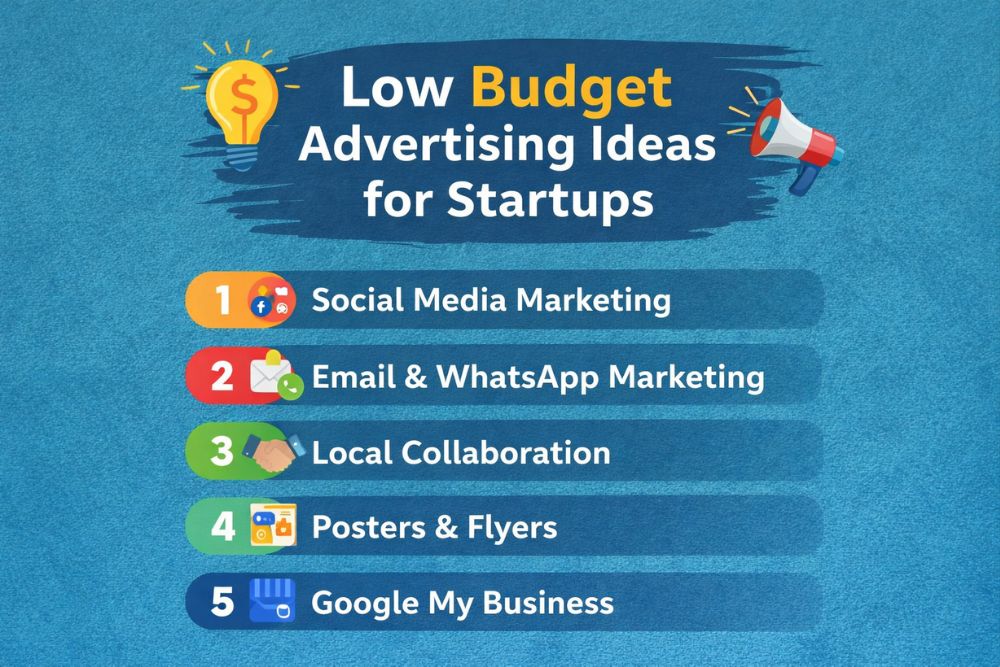

Low budget advertising ideas are the lifeline of any startup trying to grow without draining its limited resources. Starting a business in the UK is exciting but it can also be daunting when you realise that large corporations are spending millions on their marketing campaigns. The good news is that you do not need a big budget to make a big impact.
In fact, some of the most effective advertising strategies cost very little or nothing at all. With the right approach, a startup can build genuine brand awareness, attract loyal customers, and compete confidently in the market all without overspending.
This guide walks you through practical, proven, and creative advertising ideas tailored for UK startups. Whether you are pre-revenue or just getting started, these strategies are designed to deliver real results.
The most effective low budget advertising ideas for startups include organic social media marketing, content marketing and blogging, Google Business Profile optimisation, community engagement, email marketing, local PR outreach, and video content creation. These tactics require time and creativity rather than large financial investment, making them ideal for UK startups with limited resources.
Many founders assume that advertising must be expensive to be effective. However, that belief can actually hold a startup back before it even gets going. In reality, targeted, creative, and consistent advertising often outperforms expensive campaigns especially in the early stages.
According to the Federation of Small Businesses (FSB), the UK has over 5.5 million small businesses. That means your startup is entering a competitive but also very active marketplace where agility and authenticity are genuine advantages.
Low budget advertising also forces clarity. When you cannot spend freely, you think more carefully about who you are talking to, what you are saying, and why it matters. That discipline produces sharper messaging and stronger connections with your audience.
Also Read: Best Free Marketing Ideas to Grow Your Business Fast
Before you advertise anything, you need to know exactly who you are talking to. Defining your target audience is not just a marketing exercise it is the foundation of every advertising decision you will ever make.
Consider factors like age, location, interests, online behaviour, and what problems your product or service solves for them. Use free tools like Google Trends or the Office for National Statistics (ONS) to understand consumer behaviour patterns in the UK market.
Therefore, getting clear on your audience before spending a single penny is arguably the most valuable advertising investment a startup can make.
Organic social media is one of the most accessible low budget advertising ideas available to any startup. Platforms that allow you to share content, connect with followers, and build a community around your brand all at no cost are a goldmine for early-stage businesses.
Consistency is the key ingredient here. Posting regularly, engaging with comments, sharing behind-the-scenes content, and using relevant hashtags can dramatically increase your visibility without spending anything.
In the UK, research from Ofcom shows that adults spend an average of over three hours a day online. A significant portion of that time is spent on social platforms, which means your audience is almost certainly already there.
Creating helpful, informative, and well-written blog content is one of the smartest low budget advertising strategies a startup can adopt. When done correctly, it positions your brand as an authority, builds trust with your audience, and drives consistent organic traffic from search engines.
A single well-optimised blog post can continue generating traffic for months or even years after it is published. That is an extraordinary return on a relatively small time investment.
For example, a UK-based skincare startup could write blog posts about common skin concerns, ingredient guides, or seasonal skincare routines. Each post becomes a discoverable asset that draws in potential customers already searching for that information.
Moreover, content marketing aligns naturally with Google’s E-E-A-T principles demonstrating Experience, Expertise, Authoritativeness, and Trustworthiness. This makes your content more likely to rank well in search results over time.
If your startup has any local or physical presence, optimising your Google Business Profile is a non-negotiable step. It is entirely free, and it can significantly increase your visibility in local search results.
A complete and regularly updated profile with photos, business hours, services, and customer reviews can help your startup appear in the local pack results that appear at the top of Google searches.
Encourage happy customers to leave reviews. Positive reviews are a powerful form of social proof that cost you nothing and build credibility rapidly.
Email remains one of the highest-performing advertising channels available, even for startups. Building an email list from day one gives you a direct line of communication with people who have already expressed interest in what you offer.
Unlike social media, your email list belongs to you. Algorithm changes will never reduce your ability to reach your subscribers. That makes it an incredibly valuable and reliable channel.
Start by offering something of genuine value in exchange for an email address such as a free guide, a discount code, or access to exclusive content. Then send regular, helpful newsletters that inform, entertain, and occasionally promote your products or services.
Partnering with other businesses that serve the same audience as you but do not compete directly is a smart and cost-effective advertising strategy. These collaborations can take many forms, from co-created content and joint promotions to shared events and cross-referrals.
For instance, a personal trainer in Manchester could partner with a local health food shop to offer a combined starter pack for new clients. Both businesses benefit from exposure to each other’s audience at no additional cost.
This approach builds community, increases reach, and creates genuine value for customers a combination that is hard to beat at any budget level.
Do not underestimate the power of local press. Regional newspapers, community websites, and local radio stations are often looking for interesting startup stories, especially those with a local angle or community benefit.
Write a well-crafted press release about your startup launch, a milestone you have reached, or a community initiative you are running. Send it directly to journalists and editors at local media outlets.
Getting even a single piece of local coverage can drive meaningful traffic to your website and lend your brand valuable third-party credibility.
Video has become the dominant content format online. However, producing video does not have to be expensive. A smartphone, good natural lighting, and a clear message are all you need to create engaging short-form video content.
Short videos work exceptionally well for showcasing products, sharing customer testimonials, giving tours of your workspace, or explaining how your service works. They are inherently shareable, which amplifies your reach organically.
As a result, many UK startups have built significant followings simply by being consistent, genuine, and helpful through video without spending anything on production.
Online communities whether based around professional forums, Reddit communities, Facebook groups, or LinkedIn groups are full of people in your target audience discussing their challenges and looking for solutions.
By participating genuinely in these communities, answering questions, offering advice, and sharing relevant knowledge, you build awareness and trust in a natural, non-promotional way. Over time, people begin to associate your name and your brand with expertise.
The key is to add real value first. Promotional behaviour without genuine contribution is rarely well received and can damage your reputation.
Word of mouth is the oldest and arguably most effective form of advertising. Structuring a simple referral programme where existing customers receive a reward for recommending your business to friends or colleagues can generate a powerful stream of new leads.
You do not need complicated software to run a referral scheme. A simple discount, a free month of service, or a small gift card can be enough to motivate happy customers to spread the word.
Because referrals arrive with built-in trust they come recommended by someone the new customer already knows conversion rates are typically much higher than cold advertising.
Strong visual branding can make a startup look established and professional, even on a very tight budget. Free and low-cost design tools give startups access to thousands of templates for social media graphics, flyers, email headers, and more.
The ability to create attractive, on-brand visuals without hiring a designer is a significant advantage for any early-stage business. Invest time in building a consistent visual identity choose two or three brand colours, a clear font, and a professional logo and apply it consistently across all your materials.
Read More: Cheap Marketing Strategies for Small Businesses
There is no single correct answer, as it depends on your industry, growth stage, and goals. However, many startup advisors suggest allocating between 7% and 12% of projected revenue to marketing and advertising. In the very early stages, prioritising free and low-cost channels first makes good financial sense.
Yes when done consistently and strategically. Organic social media, content marketing, email marketing, and community engagement are all forms of advertising that cost little or nothing yet can produce strong, sustainable results over time. The trade-off is that they require time and consistency rather than money.
For UK-based local startups, optimising a Google Business Profile, engaging with local Facebook groups, attending community events, and reaching out to local press are amongst the most cost-effective options. These channels help build genuine local awareness and trust quickly.
In the early stages, yes organic social media can deliver meaningful reach and engagement without any paid spend. However, as a startup scales, a blend of organic and selective paid advertising often produces the best results. Start free, measure what works, and then invest in amplifying what is already succeeding.
full guide Affordable Marketing Ideas for Small Businesses
Artificial intelligence is making it easier than ever for startups to produce quality content at scale. AI writing and design tools can dramatically reduce the time needed to create blog posts, social media captions, email newsletters, and advertising copy.
This levels the playing field considerably. A solo founder can now produce the volume and variety of content that previously required a whole marketing team without spending a fortune.
Google’s AI Overviews feature means that answers to common questions are increasingly shown directly in search results, without users needing to click through to a website. For startups, this means structuring content to answer specific questions clearly and concisely so that your brand appears within these AI-generated summaries.
Optimising for this shift requires strong content that directly answers user intent, uses clear headings, and includes short, definitive answer paragraphs. This is now a core component of effective content strategy.
Consumers are increasingly interested in supporting local businesses. Positioning your startup as rooted in its local community through storytelling, community involvement, and local partnerships resonates strongly with UK audiences and can differentiate you from larger, more impersonal competitors.
Low budget advertising ideas are not a compromise they are a starting point for building something meaningful and sustainable. The strategies covered in this guide are proven, practical, and highly relevant to UK startups operating in today’s digital-first environment.
Success in advertising does not come from outspending your competitors. It comes from understanding your audience deeply, communicating your value clearly, and showing up consistently across the right channels.
Start with two or three of the ideas in this guide, commit to them for at least 90 days, measure your results honestly, and then refine your approach. That disciplined process, repeated over time, is what builds brands that last.
The best time to start is right now and the good news is that most of what you need costs nothing more than your time and creativity.
Q1. What are the best low budget advertising ideas for a new UK startup?
The most effective options include organic social media, content marketing, email marketing, Google Business Profile optimisation, local PR, and referral programmes. These deliver strong results with minimal financial investment.
Q2. How long does it take to see results from low budget advertising?
Results vary by channel. Email marketing and social media can produce engagement within days, while content marketing and SEO typically take three to six months to gain meaningful traction. Consistency is essential throughout.
Q3. Do I need a professional designer for startup advertising?
Not necessarily. Free design tools offer excellent templates that allow startups to create professional-looking visuals without prior design experience. Invest time in building a consistent brand identity early on.
Q4. Is local press still worth pursuing for UK startups?
Absolutely. Local newspapers, community websites, and regional magazines continue to hold significant trust with UK audiences. A well-placed local story can drive traffic, credibility, and community goodwill simultaneously.
Q5. Should I focus on one advertising channel or spread across several?
Start with one or two channels and master them before expanding. Spreading too thin too early reduces your effectiveness on every channel. Once you see consistent results, add additional channels gradually.